The waiting.
Oh, the waiting.
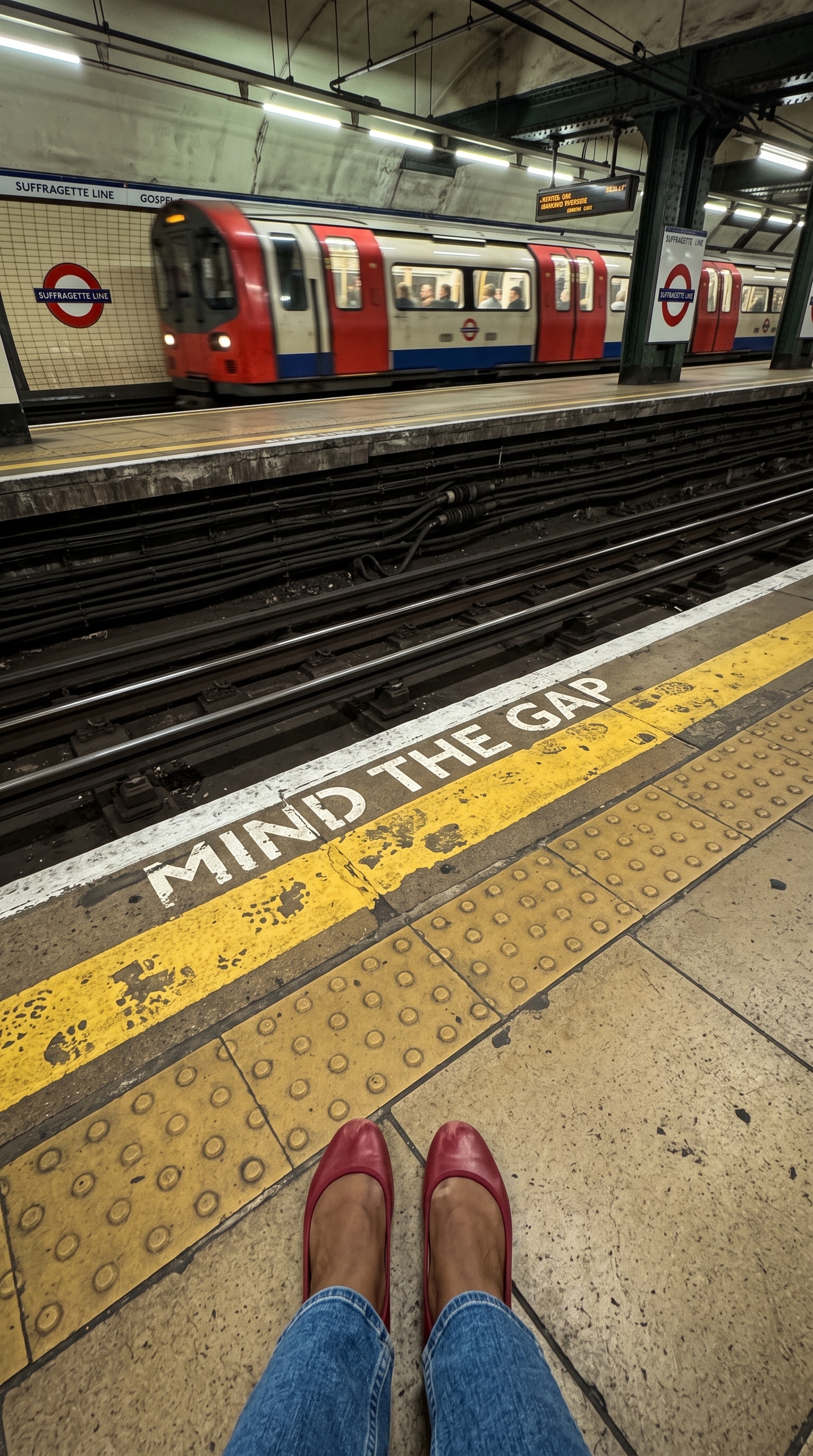
Demand for ADHD and autism diagnosis skyrocketed during COVID‑19. Referrals quadrupled. Current NHS wait times are several years in many parts of the UK. Women missed in childhood are expected to wait. Just be patient.
This isn't fair. No one should have to wait years for a life-changing diagnosis, validation and access to support. That is why we built Uma. Watch the launch.
This isn't fair. That's why we built Uma.

A mission control spoof for Uma's launch day, 9 October 2026. Uma launches free ADHD and autism screening for women stuck on NHS waitlists and invites everyone to join Mission Late Discovery and #StopMakingWomenWait.
Mission late‑discovery
On 9 October 2026 Uma began her maiden voyage to close the gender gap. Everyone can screen themselves for free during her 30-day global orbit.
Uma is in BETA. All systems are go. Her mission is to build a blueprint of how ADHD and autism present differently across sex and gender.
She has just broken the speed of sound on her flight towards making ADHD and autism screening freely available to everyone on the planet.
A global movement. neurodivergent people from around the planet are already on board Uma. Let's close the gender gap.
On board Uma
#StopMakingWomenWait
The #StopMakingWomenWait campaign launched on 9 October 2026 to demand better care. Download and share the campaign video OR the awareness cards to help us make some noise.
For decades ADHD and autistic women were presumed not to exist
Women are missed, misdiagnosed and later diagnosed than men
3-10:1
Three times as many boys and men 1 are diagnosed with autism or ADHD because of harmful sex stereotypes. This rises to 10:1 2 for autistic girls without a learning disability. Gifted girls are overlooked.
80%
Recent estimates suggest that 80% of autistic girls and women 3 have not been diagnosed before they turn 18. ADHD girls who don't fit the naughty schoolboy persona are equally missed.
30-year gap
The average age of diagnosis for boys is 7 for ADHD 4 and 4 for autism 5. For women? According to our data, 38 and 39. This is thirty years too late.
The waitlist crisis, what waiting does to women's lives, and an invitation to join mission late‑discovery.
Demand for ADHD and autism diagnosis skyrocketed during COVID‑19
QUADRUPLED
Referral rates for ADHD and autism diagnosis quadrupled during COVID‑19.
Women missed in childhood are demanding diagnosis
1:1
For the first time in history an equal number of men and women 6 are being referred. The sex gender ratio referral rate reached parity 7 between 2019 and 2023.
959,662
According to NHS data, as of June 2026, 959,662 people 8 in the UK are waiting on the NHS for an ADHD diagnosis.
294,792
As of August 2026, 294,792 people 9 are waiting on the NHS for an autism diagnosis in England alone.
2033
Current NHS waitlists 10 exceed several years in many areas of the UK. If no action is taken, women will be waiting until 2033. NICE guidelines 11 recommend waits no longer than 3 months.
£3.5k
Women unable to bear these long waits face costly private diagnoses, which average £3,500 for a combined AuDHD diagnosis. Late‑discovered women are being forced to pay the price.
This isn't fair. That's why we built Uma.
From breakdown to breakthrough service
Leanne Butler, founder of We Are More Human, tells the story behind Uma: a breakdown at 36, a late diagnosis of ADHD, autism and complex PTSD, and why she built a free screening service for women. Content note: this film talks about sexual victimisation and suicide.
How screening works
Your journey towards claiming your neurodivergent identity starts here.
Join the mission and screen yourself for free
Screen yourself for autism, ADHD and CPTSD. Voice-activated screenings, specifically designed for women and non‑binary people, collect over 1,500 data points to build a comprehensive picture of your neurodivergent brain.
Very high emotional dysregulation
Upgrade to paid to get actionable insights
Explore your neurodivergent identity. Discover your unique strengths and challenges. Uncover where you might be masking. Try new strategies to boost your mental performance and wellbeing.
Sensory profile, scored from none to super high.
- Sensory avoidance: super high
- Sensory seeking: high
- Sensory hypersensitivity: very high
- Sensory hyposensitivity: low
- Sensory overload: super high
- Intense physical sensations: super high
- Recognising body signals: very high
See if you might meet the clinical thresholds
Many women agonise over whether to pursue a medical diagnosis, or pay private costs, because they lack confidence that they meet the clinical threshold. Uma scores your responses against diagnostic criteria to give you a signal.
Just like this
A. Inattention
Download and share your self-reports
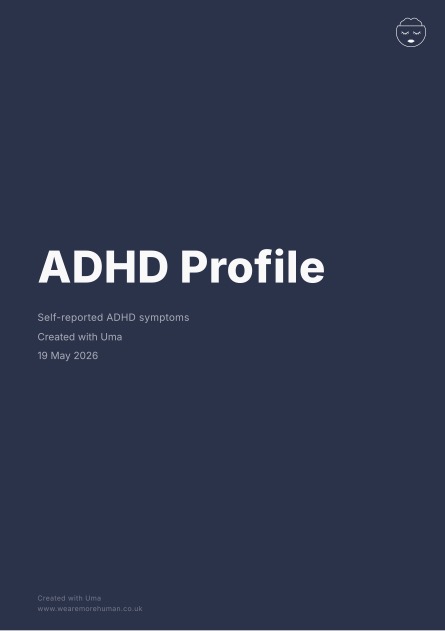
Create anonymous self-reports that summarise your medical history, trauma history, autistic traits and ADHD symptoms, all categorised according to diagnostic criteria.
Share them with your diagnostician to help them better understand your lived experience, reduce gender bias during assessments, and speed up the evidence-gathering and report-writing process.
Not just another ADHD or autism quiz.
Much more than screening.
Uma is a self‑discovery ecosystem and thriving global community that helps late‑discovered neurodivergent women and minority genders finally join the dots.
Free screening for everyone on the planet
Free screening for everyone on the planet
When Uma's founder, Leanne, began building Uma, it was with a vision to make screening freely available to every woman on the planet.
Leanne built Uma with zero funding because of one stubborn belief. Screening will change lives. Early recognition of ADHD and autism in girls and women will reduce mental illness, physical illness, homelessness, unemployment and lives lost to suicide. Recognised early and given good support, neurodivergent girls and women can thrive.
In October 2025, she launched the mini-screens. You can screen yourself for free right here, on this website. Anonymous, scored on the spot, a few minutes each. No login, no sign-up, no email.
In October 2026, she launched Uma's mission to close the gap. Uma's mission is to build the world's first blueprint of how ADHD and autism present across sex and gender. During October and Uma's 30-day orbit of the planet, we are trialling free full screening. What are you waiting for?
Build your brain‑body profile
Build your brain‑body profile
Healthcare is siloed and fragmented. The brain and body have long been treated as separate. But for neurodivergent women everything is interconnected.
There is nowhere you can screen yourself for ADHD, autism, CPTSD, the mental health difficulties that commonly co-occur with them, and the somatic super syndrome, all in one place.
Uma is the first.
She gathers all of it and builds a holistic picture of your brain and body, so you can join the dots on what is actually going on for you.
Build your brain‑body profile.
Brain‑body tracker
Coming soonBrain‑body tracker
Your energy, mood and symptoms can feel a little like the weather. Unpredictable. One day you’re fine. The next you cannot function and you cannot explain why. You’re in burnout again because you missed every stop sign your body was giving you.
The female body and brain are biologically hardwired to react more strongly to environmental stressors and hormonal fluctuations. Stress. Sleep deprivation. Alcohol. Dehydration. Hunger. Skipping exercise. Hormonal shifts. All of this makes things 10x worse. And it is trackable.
Uma’s Brain Body Tracker teaches you to listen. It connects what you report with signals from your body through wearables like Oura and Apple Watch, maps your triggers against your cycle and calendar, and alerts you before you hit the danger zone.
Once you can see the pattern, you can get ahead of it. From reacting to responding. From ignoring your body’s needs to setting healthy limits. From firefighting to self-regulation.
Take back some control.
Self‑discovery canvases
Self‑discovery canvases
Canvases that facilitate self‑discovery and help you self-advocate:
The sensory needs canvas helps you map your stressors and your soothers across all seven senses. Settle your nervous system and your emotions will follow. Almost nobody is ever told the two are linked.
Inspired by the Google user guide, the how to work with me canvas helps you tell your boss in writing, so you never have to have the conversation out loud, or rewrite the email a hundred times. Ask for the adjustments you need and share it as a polished PDF.
The job crafting canvas helps you rethink how you work, so you play to your strengths and work with your challenges. What to hand off. What to ask for support with. What deserves your energy.
Step into the library

Step into the library
Your next research rabbit hole starts here. A space to lose yourself in learning about ADHD, autism, mental health and the brain‑body connection. Curated by the Uma community, not by algorithms. A global stage for neurodivergent authors, clinical experts, advocates and allies.
Meet the creator
Catherine Asta, psychotherapist, author of Rediscovered and host of The Late Discovered Club podcast, shares her work and why closing the gender gap in late-discovered autism and women's health matters.
Meet the creator
A global stage that platforms neurodivergent women and elevates voices with lived experience. Are you a neurodivergent author or podcast host? Show your work to thousands of neurodivergent people around the globe, for free.
Books on Amazon don't come with the author sitting beside you. On here, they do. Record a 3-minute video introducing yourself, your work, and why closing the gender gap matters to you.
Self-care marketplace
Self-care marketplace
Repeat after me: self-care is not selfish. Discover evidence-based products that will help you look after your body and brain. Uma helps you see past the wellness BS. Tried and tested by neurodivergent women. Shop from your bed, in your pyjamas, at whatever hour your brain is online.
Exclusive community discounts
.webp?alt=media)
Exclusive community discounts
Free screening is supported by affiliate commission. Sign up to get exclusive discounts from Flow Neuroscience, Neurosym, Sensate, Hertility, Nikura and more...
Help us close the gender gap
Are you a brand offering products or services that support women's health and wellness? Feature on Uma's self-care marketplace and reach thousands of ADHD and autistic women.
We're looking for affiliate and dropship partners to support our mission to close the gender gap and offer free ADHD and autism screening to every person on the planet. We have a soft spot for female-founded businesses.
Access to Work assistant
UK onlyAccess to Work assistant
Brutal character limits. 90-minute timeouts with no save. No clue what you can ask for or what gets funded. It is almost like they designed this to be difficult. How on earth does anyone get an Access to Work application in?
Sounds like you need an ATW assistant.
Uma sits alongside you and hands you copy-and-paste answers, so you can speed through it in minutes instead of hours.
Access to Work can offer up to £69k a year of funding to help you thrive at work and get the support you need. They can help with the costs of coaching, specialist equipment and software, and other things that help you do your best work.
Take your application off your to-do list with Uma.
People directory
Coming soonLaura Spence, midwife and founder of Neuronatal Academy, talks about her ADHD diagnosis at 37, her work on neurodivergence in pregnancy and reproductive health, and why women should not have to wait.
People directory
Who can I trust with this?
You’ve just had a mammoth moment of self-realisation. I’m neurodivergent. Your identity has shattered, and you’re trying to figure out who you are again.
You’re left in a vulnerable place, wondering: Who do I reach out to? Who will listen? Who will believe me? Who can I trust with this?
And it’s when you’re most vulnerable that you’re most likely to be exploited. ADHD and autism diagnosis is big business.
The Uma people directory is different.
Everyone listed here has put their hand up to fund free screening for women, to subject themselves to honest reviews from the Uma community, and to provide empathetic, compassionate, respectful and validating care.
These are the people on your team.
Aurora community
Coming soonAurora community
The Aurora is a thriving neurodivergent community that helps late‑discovered neurodivergent women and minority genders share knowledge, empower each other, and support each other. A safe place to talk, to ask questions, to share what you know, and to be yourself without performing. Anonymous, moderated for kindness not conformity, and built so you never have to worry about feeling exposed.
The collective wisdom of late‑discovered neurodivergent women is far more powerful than any research article or any individual expert’s opinion. The Aurora helps members finally join the dots.
How much does Uma cost?
It's free to self-screen during our 30-day global orbit. Love the service? Leave a review or upgrade to help us close the gap.
What Uma is not
Things Uma cannot help you with.
Not a diagnostic tool
Uma does not provide or guarantee a medical diagnosis. Only a trained health professional can diagnose autism, ADHD or CPTSD.
Not a medical doctor
Uma does not provide medical advice or treatment, or prescribe medications. There are no treatments for autism; a medical diagnosis is required to access ADHD medication.
Not a therapist
Uma is not a substitute for mental health support or therapy. Many neurodivergent people carry trauma. Good therapy can be life-changing.
Not a crisis support service
Having a mental health crisis? Please reach out to your GP, call 111 or visit A&E. You can also text 'SHOUT' to 85258 for 24/7 text support.
Not for children
You must be 18 or older to use this service.
Not for men (yet)
Though anybody can sign up. Uma was co-designed with, and for, women and people assigned female at birth (AFAB). She is attuned to look for sex and gender differences.
Health data security is really bloody important
Uma is GDPR and HIPAA compliant. Here's how our clever security system works.
Uma gives women back control. We have never sold, and will never sell, personally identifiable health information to third parties. It's not our business model. We make money from subscriptions and the marketplace, not from selling personal health data. Because your health data is nobody's business but yours.
For full transparency
Here is how we use your data:
- To conduct strengths and challenges analysis and diagnostic threshold scoring.
- To recommend personalised strategies.
- To write your anonymised self-reports. Uma only uses your first initial and pronouns. You choose who you share them with.
- To further ADHD and autism research into sex and gender differences.
- To build Uma statistics, a blueprint of how ADHD and autism may present differently across sex and gender, freely accessible to all.
- To raise public awareness of the cost of late, missed and misdiagnosis.
- We never pass personally identifiable data to Uma's AI or to any third party. Everything Uma's AI sees is anonymised by us first.
Never get locked out again. Continually resetting your passwords? Do you cross your fingers and reuse the same password across multiple apps? That's why Uma uses a 4-digit PIN paired with a passkey instead of a password. Two-factor authentication keeps your data extra secure.
Data about us, for us. For decades, women and minority genders were excluded from ADHD and autism research. Not any more. Your anonymised data is helping build a blueprint of how ADHD and autism present across sex and gender.
75% of the picture is missing
For decades women were neglected in ADHD and autism research. Research focused on boys and men. There are many LGBTQ+ and transgender people within the ADHD and autistic community who were equally overlooked. When we account for this, three quarters of the picture was never built.
Uma’s mission is to build the world’s first blueprint of how ADHD and autism may present differently across sex and gender. She’s designed to calculate the true cost of missed diagnosis, late diagnosis, and misdiagnosis on women’s physical and mental health. And to make it visible.
Every person who screens on Uma contributes over 1,500 data points towards building that picture. Uma stats makes this data freely accessible to all.
Uma says goodbye respectfully. Services are like relationships. You are more likely to go back to someone or talk nicely about them to a friend if you parted on good terms. Want to end it? Uma respects that.
Uma doesn't bury cancellation buttons deep in menus. When you leave, you can choose to wipe every bit of data Uma has collected about you or donate anonymous data to help close the gender gap. You decide.
Why people love Uma
Post a review
Questions? Ask Uma.
Sometimes systems fail. If you experience a technical error, please report it. We understand that mistakes happen. Try not to panic and get in touch. You can email Leanne directly at leanne@wearemorehuman.co.uk. Please briefly describe the problem (screenshots help) and we will do our best to help you solve it.
All sales are final, as your brain‑body profile and self-reports are available instantly. Please be sure you understand the service before you upgrade to paid.
Uma launched globally on 9 October 2026.
Uma is available globally.
Yes. Uma is committed to maintaining your privacy and helping women safely self-screen. We do not sell personally identifiable health data to third parties. Uma is GDPR compliant and uses two-factor authentication.
Beyond your email login and full name, Uma does not collect any personal identifiers, such as your address, telephone number or date of birth. Your self-reports are anonymised and all health information is de-identified of any personal identifiers.
Our third-party provider, Stripe, handles payment. We are not privy to any personal details you share with them.
Yes, Uma is fully GDPR compliant. We are committed to protecting your personal data and privacy in accordance with the General Data Protection Regulation (GDPR).
Yes, Uma is HIPAA compliant.
Adult women, non‑binary and AFAB people who want to self-identify as ADHD or autistic.
Uma is not designed to support:
- Children: You must be 18 or older to use this service.
- Cisgender men: Uma is attuned to look for key differences in how autism and ADHD present across sex and gender. The service was co-designed with and for women, non‑binary and AFAB people. At this time we are not set up to support cisgender men. We welcome trans women.
No. Uma is a self-identification and screening service, not a diagnostic test or formal assessment. Only a trained health professional can provide a medical diagnosis of autism, ADHD or CPTSD. Uma can offer an indication of whether you might meet clinical thresholds based on your self-reported traits and symptoms, helping you to decide whether to proceed with a medical diagnosis. This does not guarantee a medical diagnosis.
Individually, the autism, ADHD and CPTSD screenings take 15 minutes or less. Uma will score you in real time and share your scores for each section, so there are no big surprises at the end. You will get answers in minutes. You can also use voice input to speed through the screenings.
Uma was co-designed with, and for, women, non‑binary and AFAB people. Our questions are based on the latest research into how autism and ADHD present in these populations, which is often different from the male-centric criteria used in traditional diagnostic tools.
Uma looks for known sex and gender differences, such as higher masking, rejection sensitivity, rumination, emotional dysregulation, as well as co-occurring depression, anxiety, CPTSD, and somatic symptoms related to traumatic stress, mast cell activation syndrome (MCAS) and hypermobile EDS (hEDS).
Uma is attuned to look for key differences in how autism and ADHD present across sex and gender. For example, we know that women and AFAB people are more likely to repress the urge to fidget or engage in subtle, small, repetitive movements (stimming), such as playing with their hair, jewellery or doodling. This could be because of masking or sex differences in how the motor system develops 12. While boys tend to develop stronger gross motor skills and explosive movement, girls tend to outperform boys in fine motor skills and detail tasks.
See also: Musálek et al., 202013; Surgent et al., 202514; Xiaoyu et al., 202315
We also look for divergence from what is most commonly reported by cisgender women, ensuring we account for the full spectrum of differences. For example, we know autistic women are more likely to experience sensory hypersensitivity and overload than men, reflecting sex differences in the autonomic nervous system 16 seen in the general population. However, people with conditions like anorexia 17, PCOS 18 or diabetes 19 are more likely to experience sensory blunting (also known as diabetic neuropathy 20) and co-occurring alexithymia. Both PCOS 21 and diabetes 22 are also more commonly reported by people who have experienced gender dysphoria or identify as trans. Around half of people with PCOS develop diabetes before age 40.
Uma was researched, co-designed, and tested with over 1,000 people from across the world. We are following a human-centred design process, starting with the voice of lived experience. Rather than a group of clinicians in a room brainstorming statements about how autism and ADHD present in women, we undertook primary research into how neurodivergent women experience autism and ADHD. We built the screenings from this data before testing them with participants. We will continue to test and iterate the service in response to feedback until we get it right.
The screenings have been validated with over 1,000 neurodivergent people from across the globe. We will continue to refine the screenings in response to feedback. The final step will be a peer-reviewed study with a neurotypical control group, which is considered the gold standard for psychometric validation.
Self-identification is when a person identifies as autistic without having a formal clinical diagnosis. The term "self-diagnosis" is also used, particularly in the media. This is a common choice for many people, who may be waiting for an assessment or may choose it as an alternative to seeking one at all.
It's empowering. The number one benefit is claiming your neurodivergent identity and discovering who you are by gaining understanding and explanation.
It's fast. While a formal diagnosis can take years, a self-report can give you answers in minutes.
It's free. A formal diagnosis can cost up to £3,500, whereas self-identification costs nothing.
It helps you access support. A medical diagnosis is not required to access many services or to ask for workplace adjustments in the UK. This is a common misconception. You can begin to access support as soon as you self-identify.
There is no treatment. There is no cure for autism. As a result, many of the support options available with an official diagnosis are also readily available through self-identification.
It helps you avoid an official mark on your medical records, which many people fear due to the risk of stigma and discrimination.
Continued uncertainty. You may experience continued uncertainty and second-guess yourself, which is a key reason many people choose to seek an official medical diagnosis.
Continued invalidation. Your self-identification may be questioned by friends, family, employers, or medical professionals, which can be frustrating and lead to continued invalidation.
Criticism of "self-diagnosis". "Self-diagnosis" is frequently criticised in the media, which suggests that autistic people use platforms like TikTok to "self-diagnose". Uma is different because it provides an evidence-based screening service that allows you to confidently self-identify with ADHD, autism or CPTSD and choose to get a medical diagnosis if it's right for you.
1. National Institute for Health and Care Excellence. (2025, February). Attention deficit hyperactivity disorder: How common is it? NICE Clinical Knowledge Summaries. https://cks.nice.org.uk/topics/attention-deficit-hyperactivity-disorder/background-information/prevalence/
2. Cruz, S., Conde-Pumpido Zubizarreta, S., Costa, A. D., Araújo, R., Martinho, J., Tubío-Fungueiriño, M., Sampaio, A., Cruz, R., Carracedo, A., & Fernández-Prieto, M. (2025). Is there a bias towards males in the diagnosis of autism? A systematic review and meta-analysis. Neuropsychology Review, 35(1), 153–176. https://doi.org/10.1007/s11065-023-09630-2
3. McCrossin, R. (2022). Finding the true number of females with autistic spectrum disorder by estimating the biases in initial recognition and clinical diagnosis. Children, 9(2), Article 272. https://doi.org/10.3390/children9020272
4. Centers for Disease Control and Prevention. (n.d.). Trends in the parent-report of health care provider-diagnosis and medication treatment for ADHD. https://archive.cdc.gov/www_cdc_gov/ncbddd/adhd/features/key-findings-adhd72013.html
5. Shaw, Kelly A., Williams, Susan, Patrick, Mary E., Valencia-Prado, Miguel, Durkin, Maureen S., Howerton, Ellen M., Ladd-Acosta, Christine M., Pas, Elise T., Bakian, Amanda V., Bartholomew, Paige, Nieves-Muñoz, Nancy, Sidwell, Kate, Alford, Amy, Bilder, Deborah A., DiRienzo, Monica, Fitzgerald, Robert T., Furnier, Sarah M., Hudson, Allison E., Pokoski, Olivia M., … Maenner, Matthew J. (2025). Prevalence and early identification of autism spectrum disorder among children aged 4 and 8 years: Autism and Developmental Disabilities Monitoring Network, 16 sites, United States, 2022. Morbidity and Mortality Weekly Report Surveillance Summaries, 74(2), 1–22. https://www.cdc.gov/mmwr/volumes/74/ss/ss7402a1.htm
6. Maciver, D., Singh Roy, A., Johnston, L., Boilson, M., Curnow, E., Johnstone-Cooke, V., & Rutherford, M. (2026). Are we getting better at identifying and diagnosing neurodivergent girls and women? Insights into sex ratios and age of diagnosis from clinical population data in Scotland. Autism, 30(2), 375–389. https://doi.org/10.1177/13623613251383343
7. Shah, P., Adamou, M., Cape, A., Carboni, M., Hank, D., Mukherjee, R. A. S., Shah, C., & Smith, M. (2025). Potential impact of social media and COVID-19 restrictions on adult attention-deficit rates. BJPsych Bulletin, 50(3), 230–237. https://doi.org/10.1192/bjb.2025.10162
8. NHS England. (2026, August 27). ADHD management information: August 2026. NHS England Digital. https://digital.nhs.uk/data-and-information/publications/statistical/mi-adhd/august-2026
9. NHS England. (2026, August 13). Autism statistics, July 2025 to June 2026. NHS England Digital. https://digital.nhs.uk/data-and-information/publications/statistical/autism-statistics/july-2025-to-june-2026
10. NHS England. (n.d.). Autism waiting time statistics. NHS England Digital. https://digital.nhs.uk/data-and-information/publications/statistical/autism-statistics
11. National Institute for Health and Care Excellence. (2014, January 21). Quality statement 1: Diagnostic assessment by an autism team. In Autism (Quality standard No. QS51). https://www.nice.org.uk/guidance/qs51/chapter/Quality-statement-1-Diagnostic-assessment-by-an-autism-team
12. Bondi, D., Robazza, C., Lange-Küttner, C., & Pietrangelo, T. (2022). Fine motor skills and motor control networking in developmental age. American Journal of Human Biology, 34(8), Article e23758. https://doi.org/10.1002/ajhb.23758
13. Musálek, M., Scharoun Benson, S. M., Lejcarova, A., & Bryden, P. J. (2020). Cross-lateralisation in children with attention-deficit/hyperactivity disorder and motor skill performance. International Journal of Psychology, 55(6), 973–982. https://doi.org/10.1002/ijop.12658
14. Surgent, O., Andrews, D. S., Lee, J. K., Boyle, J., Dakopolos, A., Miller, M., Ozonoff, S., Rogers, S. J., Solomon, M., Amaral, D. G., & Nordahl, C. W. (2025). Sex differences in the striatal contributions to longitudinal fine motor development in autistic children. Biological Psychiatry, 97(12), 1150–1162. https://doi.org/10.1016/j.biopsych.2025.01.005
15. Bi, X., Zhu, X., Zhu, F., Kuang, D., Song, Y., Fan, B., & Ren, Y. (2023). Sex difference of fine motor skills of school-age children with attention deficit hyperactivity disorder. Chinese Journal of Rehabilitation Theory and Practice, 29(9), 1029–1034. https://doi.org/10.3969/j.issn.1006-9771.2023.09.005
16. Chaudhry, L. A., Coovadia, Y., Schwende, B. K., Berbrier, D. E., Huckins, W., Saboune, J., Skolnik, D. A., Van Berkel, E. K., Mogil, J. S., & Usselman, C. W. (2025). Sex differences in the relationship between pain and autonomic outflow during a cold pressor test. Biology of Sex Differences, 16(1), Article 60. https://doi.org/10.1186/s13293-025-00743-2
17. Beadle, J. N., Paradiso, S., Salerno, A., & McCormick, L. M. (2013). Alexithymia, emotional empathy, and self-regulation in anorexia nervosa. Annals of Clinical Psychiatry, 25(2), 107–120. https://pmc.ncbi.nlm.nih.gov/articles/PMC3880788/
18. Scaruffi, E., Franzoi, I. G., Civilotti, C., Guglielmucci, F., La Marca, L., Tomelini, M., Veglia, F., & Granieri, A. (2019). Body image, personality profiles and alexithymia in patients with polycystic ovary syndrome (PCOS). Journal of Psychosomatic Obstetrics and Gynecology, 40(4), 294–303. https://doi.org/10.1080/0167482X.2018.1530210
19. Merlo, E. M., Tutino, R., Myles, L. A. M., Lia, M. C., & Minasi, D. (2024). Alexithymia, intolerance to uncertainty and mental health difficulties in adolescents with Type 1 diabetes mellitus. Italian Journal of Pediatrics, 50(1), Article 99. https://doi.org/10.1186/s13052-024-01647-4
20. Zhu, J., Hu, Z., Luo, Y., Liu, Y., Luo, W., Du, X., Luo, Z., Hu, J., & Peng, S. (2024). Diabetic peripheral neuropathy: Pathogenetic mechanisms and treatment. Frontiers in Endocrinology, 14, Article 1265372. https://doi.org/10.3389/fendo.2023.1265372
21. Rangi, S. K., Rehmer, J., & Ferrando, C. A. (2024). Prevalence of polycystic ovarian syndrome in young and adolescent transmasculine patients presenting for gender-affirming care. Journal of Pediatric and Adolescent Gynecology, 37(1), 51–55. https://doi.org/10.1016/j.jpag.2023.09.003
22. Maru, J., Millington, K., & Carswell, J. (2021). Greater than expected prevalence of type 1 diabetes mellitus found in an urban gender program. Transgender Health, 6(1), 57–60. https://doi.org/10.1089/trgh.2020.0027