Downregulation
Take a loooong breath out
Breathe in for 3
Breathe out for 6
Feeling overwhelmed, panicked or distressed? Rectangular breathing can help. Breathe in for 3 and out for 6. Repeat until you feel calm.
Complex post-traumatic stress disorder (CPTSD) is a mental health condition caused by prolonged exposure to trauma that feels difficult to escape.1 CPTSD includes the three core symptoms of PTSD:
CPTSD is more severe and persistent than PTSD.1 People with CPTSD experience three additional symptoms:
The latter three symptoms can be mistaken for borderline personality (BPD), also known as emotionally unstable personality (EUPD).2-8
People with CPTSD may also experience somatic symptoms, dissociation, depression, anxiety, substance misuse or suicidal thoughts.1
Try our free anonymous CPTSD mini‑screen. Real-time scoring - no email sign up necessary.
Discover if your symptoms describe CPTSD. Questions relate to the last month.
The questions that follow are from the International Trauma Questionnaire (ITQ), a clinically validated measure of ICD-11 PTSD and CPTSD. They have been adapted to the first person and the scale simplified to a yes or no answer.
Cloitre, M., Shevlin, M., Brewin, C. R., Bisson, J. I., Roberts, N. P., Maercker, A., Karatzias, T., & Hyland, P. (2018). The International Trauma Questionnaire: Development of a self-report measure of ICD-11 PTSD and Complex PTSD. Acta Psychiatrica Scandinavica, 138(6), 536–546. https://doi.org/10.1111/acps.12956
These questions relate to your experience since a traumatic experience. This experience may not have been recent. Some people might find these questions triggering. Use the SOS button for crisis signposting.
Over the past month, I have upsetting dreams that replay part of the experience or are clearly related to the experience.
Over the past month, I have powerful images or memories that sometimes come into my mind in which I feel the experience is happening again in the here and now.
Over the past month, I avoid internal reminders of the experience (for example, thoughts, feelings, or physical sensations).
Over the past month, I avoid external reminders of the experience (for example, people, places, conversations, objects, activities, or situations).
Over the past month, I am “super-alert”, watchful, or on guard.
Over the past month, I feel jumpy or easily startled.
Over the past month, these reactions to the experience have affected my relationships or social life.
Over the past month, these reactions to the experience have affected my work or my ability to work.
Over the past month, these reactions to the experience have affected other important parts of my life such as parenting, school or college work, or other important activities.
Over the past month, when I am upset, it takes me a long time to calm down.
Over the past month, I feel numb or emotionally shut down.
Over the past month, I feel like a failure.
Over the past month, I feel worthless.
Over the past month, I feel distant or cut off from people.
Over the past month, I find it hard to stay emotionally close to people.
Over the past month, difficulties with my emotions, how I see myself and my relationships have caused me concern or distress about my relationships or social life.
Over the past month, difficulties with my emotions, how I see myself and my relationships have affected my work or my ability to work.
Over the past month, difficulties with my emotions, how I see myself and my relationships have affected other important parts of my life such as parenting, school or college work, or other important activities.
Women and people assigned female at birth experience higher rates of lifetime trauma. You are not to blame. Accountability for abuse always resides with the perpetrator. Support is available.
Feeling overwhelmed, panicked or distressed? Rectangular breathing can help. Breathe in for 3 and out for 6. Repeat until you feel calm.
You don't need to deal with these thoughts alone. Talking to a human being and putting your feelings into words can help.
Call 116 123 to talk to a Samaritan. They have volunteers trained to offer empathy, compassion and emotional support 24 hours a day.
In a shutdown or struggling to verbalise how you're feeling? In the UK you can text SHOUT to 85258 for free text support.
In crisis? Call 111 or visit your local A&E. In Scotland, you can ask for the Distress Brief Intervention (DBI) service via 111 or your GP.

Signposting
Neurobetter is the world's first charity dedicated to improving the mental health of neurodivergent people.
Signposting
Free, confidential support for anyone experiencing a mental health problem. Their infoline can help you find what you need.
Women are diagnosed with CPTSD or borderline personality (BPD) - also known as emotionally unstable personality (EUPD) - 2-3x more often than men. CPTSD is often misdiagnosed as BPD.
ADHD and autistic women and non‑binary people are more likely to be misdiagnosed with borderline than their neurotypical peers.
Women are more likely to experience sexual abuse and lifetime trauma and will subsequently develop CPTSD, often misdiagnosed as BPD. BPD, in the general population, is diagnosed three times more often in women and people AFAB. This rises to 4:1 if you identify as transgender. ADHD and autistic women and minority genders are misdiagnosed at even higher rates.
ADHD and autistic women experience significantly elevated rates of trauma, gendered violence, and revictimisation. One study found that 9 out of 10 autistic women have been sexually assaulted, most multiple times, and 56% before the age of consent. Research shows that up to 80% of people diagnosed with borderline have a history of childhood sexual abuse.
Research into ADHD and autism in women only began in recent years. Previously, ADHD was thought to only affect schoolboys and autism in boys and men. Many late‑discovered neurodivergent women pursue a diagnosis of ADHD or autism to correct a misdiagnosis of BPD.
CPTSD was not formally added to the International Classification of Diseases (ICD-11) until 2018. It is still not recognised in the Diagnostic and Statistical Manual of Mental Disorders (DSM-5) (Maercker, 2021), meaning clinicians unfamiliar with CPTSD may misattribute trauma symptoms to borderline (BPD). To the untrained eye, CPTSD can look a lot like BPD.
Transdiagnostic traits are psychological characteristics, behaviours, or symptoms that exist across multiple mental health or neurological conditions rather than being specific to one diagnosis. Emotional instability is a hallmark symptom of BPD. Emotional dysregulation is a core symptom of a long list of other mental health conditions including: CPTSD, premenstrual dysphoric disorder (PMDD), bipolar, depression, and other mood disorders.
Impulsivity is another hallmark BPD symptom. Impulsivity, or acting on emotion without fully thinking things through, is a core symptom of an equally long list including: ADHD, CPTSD, PMDD, bipolar, ASPD, and conduct disorder. Additionally, CPTSD criteria explicitly state, "reckless or self-destructive behaviour".
The BPD diagnostic criteria require that symptoms are pervasive and long-term. But research shows that half of people with BPD recover and no longer meet the diagnostic threshold within 5 years (Zelkowitz, 2007). Bessel van der Kolk argues that most people diagnosed with BPD have experienced trauma and would benefit from a corrected diagnosis of CPTSD.
Another hallmark BPD symptom is chronic emptiness. Many ADHD and autistic people struggle with alexithymia, difficulties identifying emotions, and alexisomia, difficulties identifying body sensations. Additionally, emotional numbness is a core symptom of CPTSD and depression, often mistaken for the chronic emptiness of BPD.
BPD is synonymous with a fear of abandonment and mixed attachment styles (fearful and avoidant). However, this is also described in the CPTSD diagnostic criteria, where children develop mixed attachment to their parents. Rejection sensitivity is an extreme emotional or behavioural reaction to real or perceived rejection, criticism, exclusion, or abandonment. It is a symptom of borderline, CPTSD, PMDD, and social anxiety disorder, and is increasingly viewed as a trauma response.
The extreme female brain (EFB) theory labelled women as hyper-mentalisers and argued that women were more prone to conditions involving mania or psychosis, specifically borderline, bipolar and schizophrenia. Hyper-mentalising is the tendency to over-analyse others and misinterpret neutral faces as negative. This is a symptom of hypervigilance in both BPD and CPTSD, related to an awareness of threat rather than inherent psychosis.
Uma is designed to help late‑discovered women and non‑binary people disclose their CPTSD symptoms and trauma history in writing, preventing retraumatisation and reducing the risk of misdiagnosis.
Women and people assigned female at birth (AFAB) experience higher rates of lifetime trauma and are 2-3x more likely to develop CPTSD. Autistic and ADHD women and minority genders report significantly elevated levels of gendered violence and lifetime trauma relative to their neurotypical peers.
The symptoms of co-occurring CPTSD overlap with both ADHD and autism, which can make them tricky to tell apart.
The timing of symptoms relative to trauma is key for clinicians to provide an accurate differential or combined diagnosis. Uma screens for PTSD symptoms with clinically validated psychometrics; she is designed to help you report your trauma history in writing, including the age of these experiences.
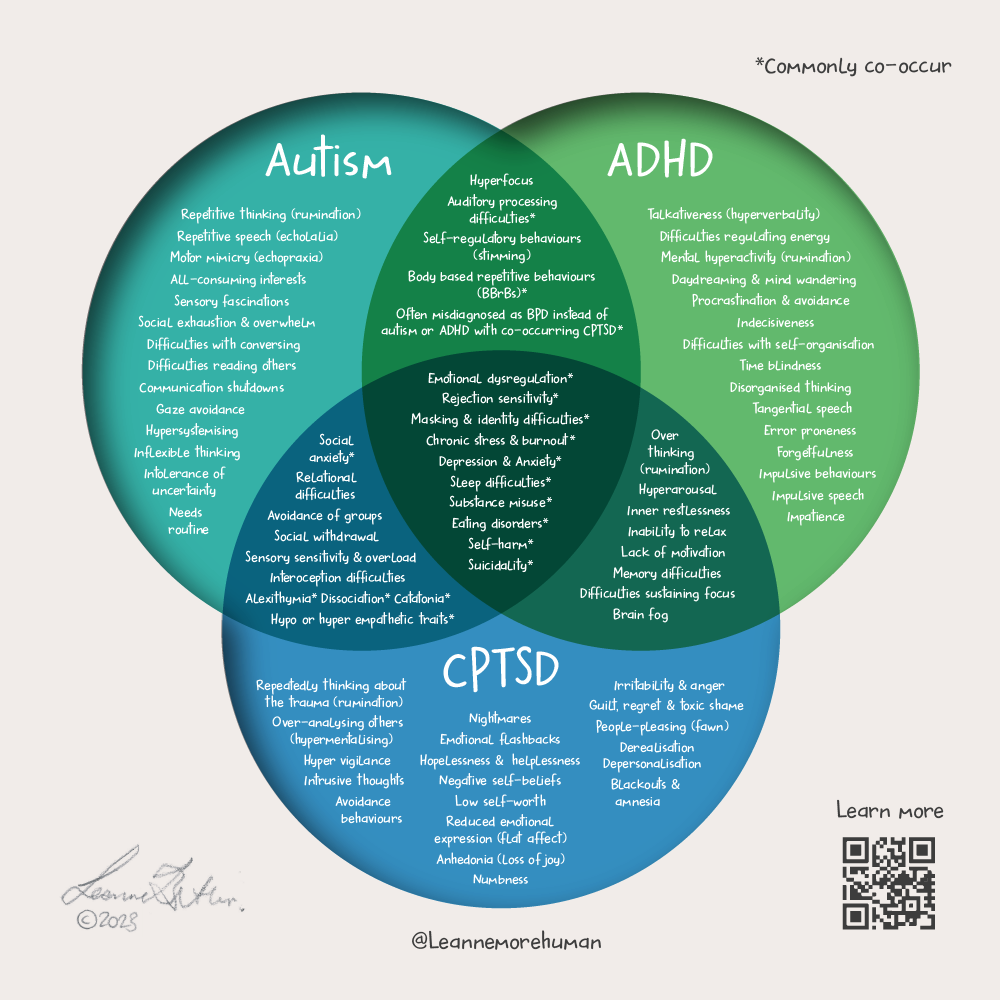
Complex PTSD (CPTSD) is a mental health condition that can develop from prolonged or repeated exposure to trauma from which there is little or no chance of escape, such as long-term domestic abuse, child abuse, or torture.
Unlike PTSD, which is often tied to a single traumatic event, CPTSD is characterised by a pervasive and long-lasting impact on a person's life, including difficulties with emotional regulation, sense of self, and relationships. People with CPTSD typically report a persistent re-experiencing of the trauma, avoidance of reminders of the trauma, hypervigilance, feelings of shame, guilt and worthlessness, and difficulties in relationships.
CPTSD, in the general population, is 2-3x more common 9 in women and people AFAB. CPTSD is frequently misdiagnosed as BPD. CPTSD often co-occurs with autism and ADHD, particularly in women and AFAB people due to high rates of intergenerational trauma.
CPTSD is a relatively new diagnosis. CPTSD was added to the ICD-11 in 2018. CPTSD is still not a formal diagnosis in the DSM-5 (Maercker, 2021) 10
CPTSD affects around 1% to 7% of the population. It is significantly more common in women and people assigned female at birth (AFAB), who are 2 to 3 times more likely to develop the condition. This is often due to higher lifetime exposure to interpersonal and domestic trauma.
CPTSD is caused by prolonged exposure to trauma. Common causes include:
You are more likely to develop it if the trauma happened at an early age, lasted for a long time, or was caused by someone close to you.
Yes. It is very common for neurodivergent people to also have CPTSD. Because autistic and ADHD people process the world differently, they often experience higher rates of social rejection, sensory overwhelm and systemic exclusion, which can be traumatic over time.
A sensitive nervous system can make a person more vulnerable to the effects of environmental stressors, meaning neurodivergence and trauma often exist together.
No. Trauma does not cause ADHD or autism. These are innate neurological differences that a person is born with. However, the two are deeply linked. Neurodivergent people are more likely to experience trauma, and CPTSD symptoms can sometimes mimic or worsen the presentation of ADHD and autistic traits.
Unlike a visual flashback where you see a memory, an emotional flashback is an intense feeling of being back in the trauma. You may suddenly feel small, helpless, terrified or ashamed without a clear reason in the present.
Your body is reacting to a trigger as if the original threat were happening now, even if you do not have a specific visual memory of the event.
Hypervigilance is a state of constant alertness where you are always scanning your environment for threats. Hyperarousal is the physiological side of this, where your "fight or flight" system is stuck in the on position.
This can lead to being easily startled, having trouble sleeping, feeling irritable or finding it difficult to concentrate because your body believes it is in danger.
Somatic symptoms are physical sensations or bodily pains that are caused or made worse by emotional distress and trauma. Because the mind and body are connected, the "alarm" from CPTSD often manifests physically.
Common somatic symptoms include chronic muscle tension, headaches, digestive issues, unexplained fatigue, and chest tightness. These are real physical experiences, even though they stem from the nervous system being stuck in a survival state.
Sometimes, as a way to cope with overwhelming experiences, people may experience moments of detachment or feel disconnected from themselves, their memories, or their surroundings. These are known as dissociative experiences.
Dissociation can be caused by trauma, pain or sensory overload. Dissociation is a recognised symptom of CPTSD 11 and BPD 12. Dissociation, in the general population, is more common in women and AFAB people.
Alexithymia is a trait which involves difficulty identifying, labelling and describing one's own emotions.
While commonly reported by ADHD and autistic people, Alexithymia is not an ADHD symptom or an autistic trait. Alexithymia is theorised to be a trauma response.
Alexithymia is often conflated with both dissociation and Alexisomia 13 - which involves difficulties identifying, distinguishing and describing one's own bodily sensations and physical feelings. You may also hear people describe this as "difficulties with interoception."
Alexithymia, in the general population, is more common in men 14 and people AMAB. Other research shows elevated levels of alexithymia amongst people who identify as trans. 15 Research shows a link with alexithymia and eating disorders 16 particularly in ADHD and autistic women and AFAB with anorexia or bulimia.
Masking, or "camouflaging," refers to the active efforts marginalised people make to conceal or modify aspects of their identity, behaviour, or communication to avoid discrimination, exclusion, rejection, bullying, or abuse. This includes both conscious imitation of others' actions or language and unconscious imitation, where people blend in or conform to social expectations without realising it (Pearson et al., 2021). 17
Masking is increasingly recognised as a trauma response. Research shows that neurodivergent women mask more than men, and minority genders mask at higher rates still. (Hull et al., 2020) 18. Masking is also commonly reported among people who identify as LGBTQIA+.
Rejection Sensitivity Dysphoria (RSD), also simply described as "rejection sensitivity," is an extreme adverse emotional, physiological, or behavioural reaction to perceived or actual rejection, abandonment, criticism, blame, or exclusion.
While it is often discussed in relation to ADHD, RSD is not recognised as a symptom of ADHD nor included in its diagnostic criteria. Rejection sensitivity is a recognised symptom of Social anxiety, Avoidant personality, PMDD, BPD and CPTSD. These mental health conditions, in the general population, are 2-3x more common in women and people AFAB.
RSD is increasingly understood as a trauma response. Relationally, ADHD and autistic women face significantly higher levels of victimisation, bullying, exclusion, exploitation, and abuse compared to their neurotypical peers. Consequently, they may be more sensitive to rejection as adults.
Borderline personality (BPD), also known as emotionally unstable personality (EUPD), is a mental health condition that causes difficulties in regulating emotions and challenges in how you relate to yourself and others. BPD is characterised by a deep fear of abandonment, rapidly shifting emotions, impulsivity and an unstable sense of self.
BPD, in the general population, is diagnosed 3x more often 19 in women and people AFAB. This rises to 4:1 if you identify as trans 20. BPD is a common misdiagnosis amongst late‑discovered ADHD and autistic women, non‑binary and AFAB people, particularly those with co-occurring CPTSD.
BPD is increasingly viewed as a trauma response. Around half of people with BPD recover and no longer meet the threshold within 5 years (Phyllis Zelkowitz, 2007). 22
Bessel Van Der Kolk, a psychiatrist who specialises in trauma, argues that most people diagnosed with BPD would benefit from a corrected diagnosis of CPTSD. The charity Mind offers a page on Why personality diagnosis is controversial .
1. World Health Organization. (2019). International Statistical Classification of Diseases and Related Health Problems (11th ed.). ICD-11 Code 6B41: Complex Post Traumatic Stress Disorder. https://icd.who.int/browse/2024-01/mms/en#585833559
2. Cloitre, M., Garvert, D. W., Brewin, C. R., Bryant, R. A., & Maercker, A. (2013). Evidence for proposed ICD-11 PTSD and complex PTSD: A latent profile analysis. European Journal of Psychotraumatology, 4(1), 20706. https://doi.org/10.3402/ejpt.v4i0.20706
3. Simon, J. J., Spiegler, K., Coulibaly, K., Stopyra, M. A., Friederich, H.-C., Gruber, O., & Nikendei, C. (2025). Beyond diagnosis: Symptom patterns across complex PTSD and borderline personality disorder. Frontiers in Psychiatry, 16, 1668821. https://doi.org/10.3389/fpsyt.2025.1668821
4. Karatzias, T., Bohus, M., Shevlin, M., Hyland, P., Bisson, J. I., Roberts, N., & Cloitre, M. (2023). Distinguishing between ICD-11 complex post-traumatic stress disorder and borderline personality disorder: Clinical guide and recommendations for future research. British Journal of Psychiatry, 223(3), 403–406. https://doi.org/10.1192/bjp.2023.80
5. Hyland, P., Karatzias, T., Shevlin, M., & Cloitre, M. (2019). Examining the discriminant validity of complex posttraumatic stress disorder and borderline personality disorder symptoms: Results from a United Kingdom population sample. Journal of Traumatic Stress, 32(6), 855–863. https://doi.org/10.1002/jts.22444
6. Sarr, R., Spain, D., Quinton, A. M. G., Happé, F., Brewin, C. R., Radcliffe, J., ... & Rumball, F. (2025). Differential diagnosis of autism, attachment disorders, complex post-traumatic stress disorder and emotionally unstable personality disorder: A Delphi study. British Journal of Psychology, 116(1), 1–33. https://doi.org/10.1111/bjop.12731
7. Pascuzzi, B., & Keeley, J. (2026). Beliefs related to diagnosing borderline personality disorder and complex post-traumatic stress disorder. British Journal of Clinical Psychology. Advance online publication. https://doi.org/10.1111/bjc.70063
8. Galvez-Merlin, A., Diaz-Gonzalez, S., Julian-Montaner, E., Fuentes-Garcia, N., Gonzalez-Gomez, M., Lopez-Villatoro, J. M., Diaz-Marsa, M., & Carrasco, J. L. (2026). Complex post-traumatic stress disorder and borderline personality disorder: A systematic review of diagnostic distinction and comorbidity. Healthcare, 14(16), 2527. https://doi.org/10.3390/healthcare14162527
9. Hiscox, L. V., Sharp, T. H., Olff, M., Seedat, S., & Halligan, S. L. (2023). Sex-based contributors to and consequences of post-traumatic stress disorder. Current Psychiatry Reports, 25(5), 233–245. https://doi.org/10.1007/s11920-023-01421-z
10. Maercker, A. (2021). Development of the new CPTSD diagnosis for ICD-11. Borderline Personality Disorder and Emotion Dysregulation, 8(1), 7. https://doi.org/10.1186/s40479-021-00148-8
11. World Health Organization. (2025). International Statistical Classification of Diseases and Related Health Problems (11th ed., 2025-01 release). ICD-11 Code 6B41: Complex Post Traumatic Stress Disorder. https://icd.who.int/browse/2025-01/mms/en#585833559
12. Borderline personality disorder. (2026). In StatPearls. StatPearls Publishing. https://www.ncbi.nlm.nih.gov/books/NBK430883/
13. Oka, T. (2020). Shitsu-taikan-sho (alexisomia): A historical review and its clinical importance. BioPsychoSocial Medicine, 14(1), 23. https://doi.org/10.1186/s13030-020-00193-9
14. Levant, R. F., Hall, R. J., Williams, C. M., & Hasan, N. T. (2009). Gender differences in alexithymia. Psychology of Men & Masculinity, 10(3), 190–203. https://doi.org/10.1037/a0015652
15. Kallitsounaki, A., & Williams, D. M. (2023). Brief report: An exploration of alexithymia in autistic and nonautistic transgender adults. Autism in Adulthood, 5(2), 210–216. https://doi.org/10.1089/aut.2022.0113
16. Nowakowski, M. E., McFarlane, T., & Cassin, S. (2013). Alexithymia and eating disorders: A critical review of the literature. Journal of Eating Disorders, 1, 21. https://doi.org/10.1186/2050-2974-1-21
17. Pearson, A., & Rose, K. (2021). A conceptual analysis of autistic masking: Understanding the narrative of stigma and the illusion of choice. Autism in Adulthood, 3(1), 52–60. https://doi.org/10.1089/aut.2020.0043
18. Hull, L., Lai, M.-C., Baron-Cohen, S., Allison, C., Smith, P., Petrides, K. V., & Mandy, W. (2020). Gender differences in self-reported camouflaging in autistic and non-autistic adults. Autism, 24(2), 352–363. https://doi.org/10.1177/1362361319864804
19. Skodol, A. E., & Bender, D. S. (2003). Why are women diagnosed borderline more than men? Psychiatric Quarterly, 74(4), 349–360. https://doi.org/10.1023/A:1026087410516
20. Rodriguez-Seijas, C., Warren, M., Vupputuri, P., & Hawthorne, S. (2024). Bias in the diagnosis of borderline personality disorder among sexual- and gender-minority persons: Results from a vignette-based experiment. Clinical Psychological Science, 13(2), 388–406. https://doi.org/10.1177/21677026241267954
21. Ditrich, I., Philipsen, A., & Matthies, S. (2021). Borderline personality disorder (BPD) and attention deficit hyperactivity disorder (ADHD) revisited: A review-update on common grounds and subtle distinctions. Borderline Personality Disorder and Emotion Dysregulation, 8(1), 22. https://doi.org/10.1186/s40479-021-00162-w
22. Zelkowitz, P., Paris, J., Guzder, J., Feldman, R., Roy, C., & Rosval, L. (2007). A five-year follow-up of patients with borderline pathology of childhood. Journal of Personality Disorders, 21(6), 664–674. https://doi.org/10.1521/pedi.2007.21.6.664